
Iceland
Iceland (local: Lydhveldidh Island) is an island country considered to be part of Scandinavia, between the Greenland Sea and the North Atlantic Ocean. The capital is Reykjavik, the northernmost national capital in the world.
Settled by Norwegian and Celtic immigrants during the late 9th and 10th centuries, Iceland boasts the world's oldest functioning legislative assembly, the Althing, established in 930. Independent for over 300 years, Iceland was subsequently ruled by Norway and Denmark. Limited home rule from Denmark was granted in 1874. In 1918, Iceland became a sovereign state under the Danish Crown and complete independence attained in 1944. Literacy, longevity, income, and social cohesion are first-rate by world standards.
Geography
Iceland is divided into eight regions: Austurland, Hofudhborgarsvaedhi, Nordhurland Eystra, Nordhurland Vestra, Sudhurland, Sudhurnes, Vestfirdhir and Vesturland.
Terrain: mostly plateau interspersed with mountain peaks, icefields; coast deeply indented by bays and fiords. More land covered by glaciers than in all of continental Europe. Natural hazards: earthquakes and volcanic activity. Highest point: Hvannadalshnukur 2,119 m (at Vatnajokull glacier).
Total area: 103,000 km², coastline: 4,988 km.
Climate: temperate; moderated by North Atlantic Current; mild, windy winters; damp, cool summers.
Ports and harbors: Akureyri, Hornafjordhur, Isafjordhur, Keflavik, Raufarhofn, Reykjavik, Seydhisfjordhur, Straumsvik, Vesttmannaeyjar.
Main source: CIA - The World Factbook.

People
Population: 343,518 (2018 est.)
Religions: Evangelical Lutheran Church of Iceland (official) 67.2%, Roman Catholic 3.9%, Reykjavik Free Church 2.8%, Hafnarfjordur Free Church 2%, Asatru Association 1.2%, The Independent Congregation .9, other religions 4% (includes Zuist and Pentecostal), none 6.7%, other or unspecified 11.3% (2018 est.).
Ethnic groups: homogeneous mixture of descendants of Norse and Celts 81%, population with foreign background 19% (2018 est.).
Language: Icelandic, English, Nordic languages, German.
Economy
Iceland's economy is basically capitalistic, yet with an extensive welfare system (including generous housing subsidies), low unemployment, and remarkably even distribution of income. In the absence of other natural resources (except for abundant geothermal power), the economy depends heavily on the fishing industry, which provides 70% of export earnings and employs 12% of the work force.
Main source: CIA - The World Factbook.
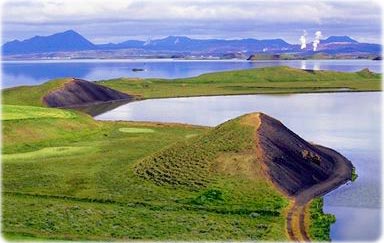
The Myvatn Lake with old volcanoes, Iceland.
◄ Europe |
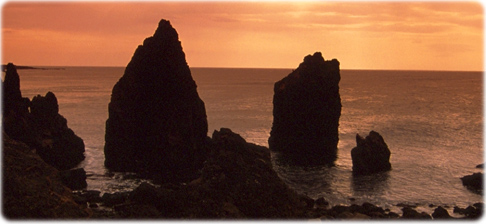
Sunset in Iceland's coast.

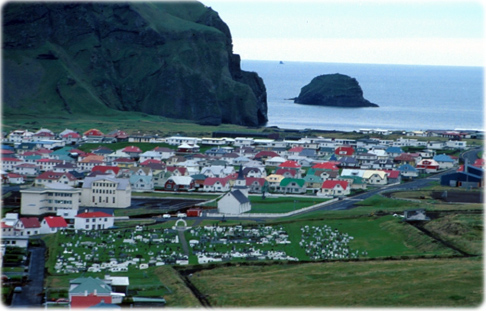
Village in Iceland
|
Copyright © Geographic Guide - Travel European Continent. |
Iceland
