Europe Paris London, Venice

Paris, London, Venice in Europe

Geographic Guide Europe - Paris, London


Images of Europe

The name Europe is probably derived from Europa, mother of the legendary King Minos in Greek mythology. Europe is the cradle of the Occidental Civilization and  the stage of scientific and cultural revolutions. During the 18th and 19th centuries, Europe was the most powerful region of the world.

Europe's population is superior to 726 million inhabitants and includes a large number of ethnic groups. The average annual growth rate for the European population, from 1985 to 1995, was only 0.28%, the least of all continents. In recent years the population is actually decreasing.

The continent shelters the second biggest economic block of the Planet: the European Union, formed by 15 countries. Twelve countries adopt the same currency: the euro.
To know more visit Pictures of Europe.


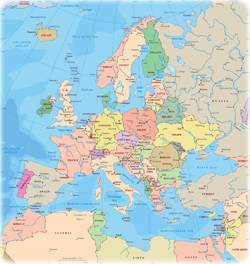
Europe maps


All rights reserved


To Geographic Guide Home Page


Granada - Spain

Granada was inhabited by the Moors from 711 until 1492. Its splendor was reached in 1238, when the Moorish kingdom of Granada stretched from Gibraltar to Murcia. Granada is a city in the region of Andalusia, at the foot of the Sierra Nevada mountains, and crossed by two rivers, the Genil and the Darro.

Granada has magnificent old buildings and narrow streets, from a time when the city was under the rule of the Moorish kings.

To learn more: Pictures of Spain.


The Moorish Palace of Alhambra, in Granada, Spain.

The Moorish Palace of Alhambra, in Granada


Gondolas in Venice and the Rialto bridge.

Gondolas and the Rialto bridge, in Venice, Italy.

Venice - Italy

Venice is one of the most beautiful and picturesque cities of the world. It was constructed on a group of small islands, in the Adriatic coast of Italy. Venice is cut by some canals and the islands are connected by several bridges.

Venice has buildings with impressive architecture, many of them are memories of the Middle Ages, when Venice had a powerful empire and was an important cultural center of Europe.


Mediterranean Sea photographed by NASA.


Paris

Art and poetry contaminate the visitors of Paris. The city, with more than ten million residents, is the political and intellectual capital of France.

Paris also enchants for its buildings. The Eiffel Tower, for example, is a revolutionary architecture build by Gustave Eiffel (1832-1923) for the Universal Exhibition of 1889.

See also: Pictures of Paris


The Arc of the Triumph, in Paris.

Arc of the Triumph, in Paris


London

A city of strong traditions, capital of the United Kingdom and a metropolis with about 7,4 million residents. London was the most influent city of the world during the 18th and 19th centuries, economically and politically. During the World War II, it was intensively bombed by the Germans, causing many deaths and massive destruction.

To learn more see Pictures of UK.


Thames River and the Houses of parliament at dusk, Westminster, London.

Houses of parliament at dusk, Westminster, London


◄Geographic Guide


Mediterranean Sea - Europe and Africa.