Map of Brazil, Argentina and Uruguay

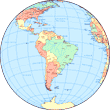
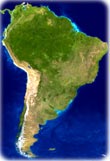
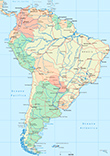
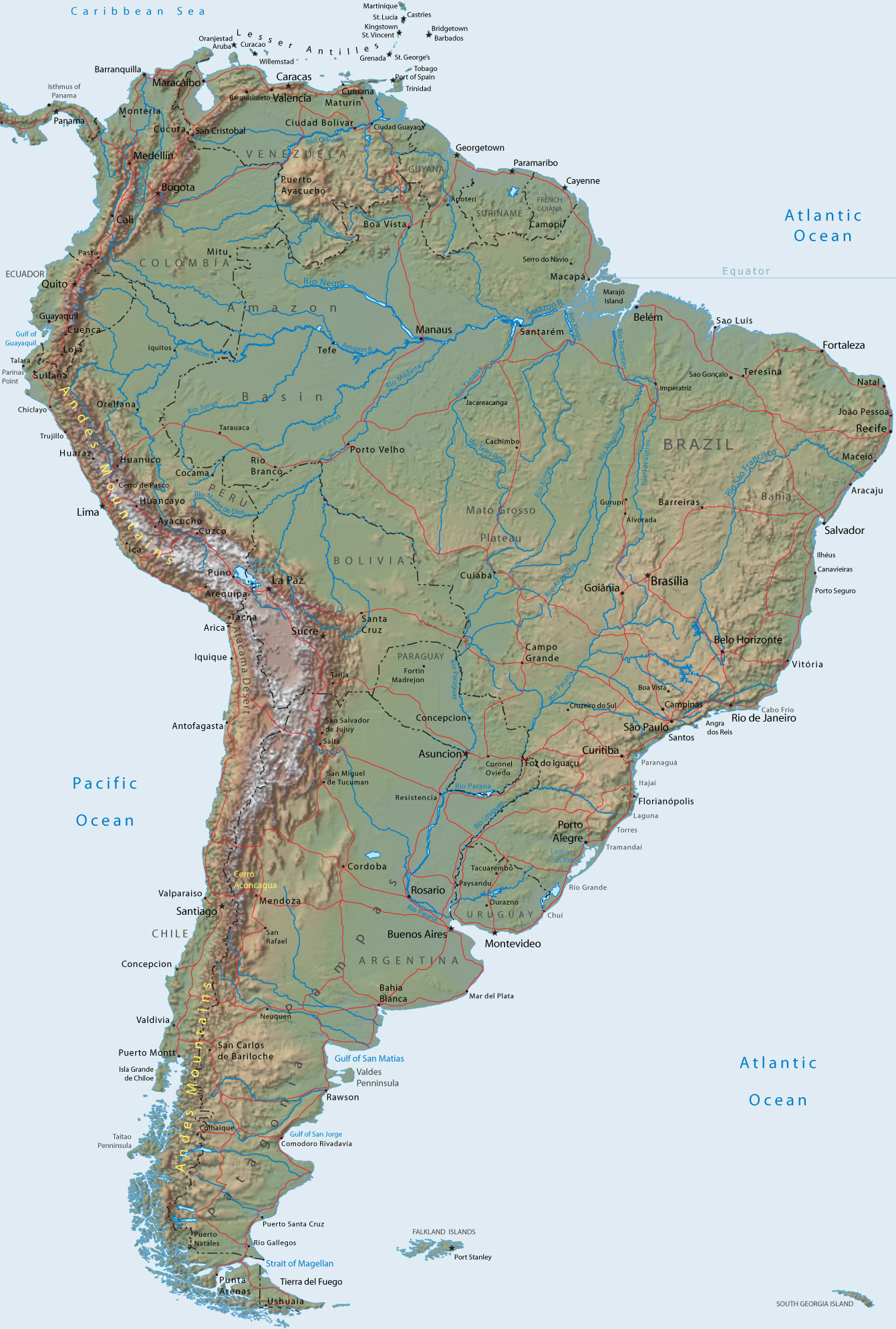
Map of Brazil, Argentina, Paraguay, Bolivia, Colombia and Uruguay. In South America there are twelve developing countries and about 348 million people. It has the greatest linguistic integration of all the continents: the great majority of the people speaks Portuguese or Spanish. The Amazon River, in South America, is the world's greatest river in volume of water and size of drainage basin. Its length of 6,400km is only slightly surpassed by the Nile River, with 6,671km. On the other hand, the flow of water per second at mouth in the Amazon River is 175,000 cubic meters, while in Nile River is only 3,100 cubic meters. The Galapagos is a group of volcanic islands in the Pacific Ocean. Some volcanoes in the islands are still active. They constitute a province of Ecuador and are protected as a wildlife sanctuary, since 1935, where birds coexist with iguanas, sea lions and several other animals. The principal islands are Isabela, San Cristóbal, San Salvador, Santa María and Santa Cruz.
The islands population is about 15,000. Puerto Baquerizo Moreno, on San Cristóbal, is the administrative center. In 1978, it was declared a UNESCO World Heritage Site. The Isolation of the Galapagos in the Pacific Ocean allowed the development of a peculiar ecosystem. Many varieties of wildlife are not found anywhere else, including six species of giant tortoises that give the islands their Spanish name. The observation of the wildlife in Galapagos produced important inferences to the development of the Charles Darwin's theory of evolution. The English naturalist arrived at the archipelago in the expedition of the Beagle, between 1831 and 1836. Buenos Aires, located on the western bank of the Rio de la Plata, is the economic, political and cultural center of Argentina. It is a great metropolis with twelve million people with high cultural standard.
Map of Brazil, Argentina, Paraguay, Bolivia, Colombia and Uruguay. In South America there are twelve developing countries and about 348 million people. It has the greatest linguistic integration of all the continents: the great majority of the people speaks Portuguese or Spanish. The Amazon River, in South America, is the world's greatest river in volume of water and size of drainage basin. Its length of 6,400km is only slightly surpassed by the Nile River, with 6,671km. On the other hand, the flow of water per second at mouth in the Amazon River is 175,000 cubic meters, while in Nile River is only 3,100 cubic meters. The Galapagos is a group of volcanic islands in the Pacific Ocean. Some volcanoes in the islands are still active. They constitute a province of Ecuador and are protected as a wildlife sanctuary, since 1935, where birds coexist with iguanas, sea lions and several other animals. The principal islands are Isabela, San Cristóbal, San Salvador, Santa María and Santa Cruz. The islands population is about 15,000. Puerto Baquerizo Moreno, on San Cristóbal, is the administrative center. In 1978, it was declared a UNESCO World Heritage Site. The Isolation of the Galapagos in the Pacific Ocean allowed the development of a peculiar ecosystem. Many varieties of wildlife are not found anywhere else, including six species of giant tortoises that give the islands their Spanish name. The observation of the wildlife in Galapagos produced important inferences to the development of the Charles Darwin's theory of evolution. The English naturalist arrived at the archipelago in the expedition of the Beagle, between 1831 and 1836. Buenos Aires, located on the western bank of the Rio de la Plata, is the economic, political and cultural center of Argentina. It is a great metropolis with twelve million people with high cultural standard.
Map of Brazil, Argentina, Paraguay, Bolivia, Colombia and Uruguay. In South America there are twelve developing countries and about 348 million people. It has the greatest linguistic integration of all the continents: the great majority of the people speaks Portuguese or Spanish. The Amazon River, in South America, is the world's greatest river in volume of water and size of drainage basin. Its length of 6,400km is only slightly surpassed by the Nile River, with 6,671km. On the other hand, the flow of water per second at mouth in the Amazon River is 175,000 cubic meters, while in Nile River is only 3,100 cubic meters. The Galapagos is a group of volcanic islands in the Pacific Ocean. Some volcanoes in the islands are still active. They constitute a province of Ecuador and are protected as a wildlife sanctuary, since 1935, where birds coexist with iguanas, sea lions and several other animals. The principal islands are Isabela, San Cristóbal, San Salvador, Santa María and Santa Cruz.
The islands population is about 15,000. Puerto Baquerizo Moreno, on San Cristóbal, is the administrative center. In 1978, it was declared a UNESCO World Heritage Site. The Isolation of the Galapagos in the Pacific Ocean allowed the development of a peculiar ecosystem. Many varieties of wildlife are not found anywhere else, including six species of giant tortoises that give the islands their Spanish name. The observation of the wildlife in Galapagos produced important inferences to the development of the Charles Darwin's theory of evolution. The English naturalist arrived at the archipelago in the expedition of the Beagle, between 1831 and 1836. Buenos Aires, located on the western bank of the Rio de la Plata, is the economic, political and cultural center of Argentina. It is a great metropolis with twelve million people with high cultural standard.
Map of Brazil, Argentina, Paraguay, Bolivia, Colombia and Uruguay. In South America there are twelve developing countries and about 348 million people. It has the greatest linguistic integration of all the continents: the great majority of the people speaks Portuguese or Spanish. The Amazon River, in South America, is the world's greatest river in volume of water and size of drainage basin. Its length of 6,400km is only slightly surpassed by the Nile River, with 6,671km. On the other hand, the flow of water per second at mouth in the Amazon River is 175,000 cubic meters, while in Nile River is only 3,100 cubic meters. The Galapagos is a group of volcanic islands in the Pacific Ocean. Some volcanoes in the islands are still active. They constitute a province of Ecuador and are protected as a wildlife sanctuary, since 1935, where birds coexist with iguanas, sea lions and several other animals. The principal islands are Isabela, San Cristóbal, San Salvador, Santa María and Santa Cruz.
The islands population is about 15,000. Puerto Baquerizo Moreno, on San Cristóbal, is the administrative center. In 1978, it was declared a UNESCO World Heritage Site. The Isolation of the Galapagos in the Pacific Ocean allowed the development of a peculiar ecosystem. Many varieties of wildlife are not found anywhere else, including six species of giant tortoises that give the islands their Spanish name. The observation of the wildlife in Galapagos produced important inferences to the development of the Charles Darwin's theory of evolution. The English naturalist arrived at the archipelago in the expedition of the Beagle, between 1831 and 1836. Buenos Aires, located on the western bank of the Rio de la Plata, is the economic, political and cultural center of Argentina. It is a great metropolis with twelve million people with high cultural standard.
Map of Brazil, Argentina, Paraguay, Bolivia, Colombia and Uruguay. In South America there are twelve developing countries and about 348 million people. It has the greatest linguistic integration of all the continents: the great majority of the people speaks Portuguese or Spanish. The Amazon River, in South America, is the world's greatest river in volume of water and size of drainage basin. Its length of 6,400km is only slightly surpassed by the Nile River, with 6,671km. On the other hand, the flow of water per second at mouth in the Amazon River is 175,000 cubic meters, while in Nile River is only 3,100 cubic meters. The Galapagos is a group of volcanic islands in the Pacific Ocean. Some volcanoes in the islands are still active. They constitute a province of Ecuador and are protected as a wildlife sanctuary, since 1935, where birds coexist with iguanas, sea lions and several other animals. The principal islands are Isabela, San Cristóbal, San Salvador, Santa María and Santa Cruz. The islands population is about 15,000. Puerto Baquerizo Moreno, on San Cristóbal, is the administrative center. In 1978, it was declared a UNESCO World Heritage Site. The Isolation of the Galapagos in the Pacific Ocean allowed the development of a peculiar ecosystem. Many varieties of wildlife are not found anywhere else, including six species of giant tortoises that give the islands their Spanish name. The observation of the wildlife in Galapagos produced important inferences to the development of the Charles Darwin's theory of evolution. The English naturalist arrived at the archipelago in the expedition of the Beagle, between 1831 and 1836. Buenos Aires, located on the western bank of the Rio de la Plata, is the economic, political and cultural center of Argentina. It is a great metropolis with twelve million people with high cultural standard.
Map of Brazil, Argentina, Paraguay, Bolivia, Colombia and Uruguay. In South America there are twelve developing countries and about 348 million people. It has the greatest linguistic integration of all the continents: the great majority of the people speaks Portuguese or Spanish. The Amazon River, in South America, is the world's greatest river in volume of water and size of drainage basin. Its length of 6,400km is only slightly surpassed by the Nile River, with 6,671km. On the other hand, the flow of water per second at mouth in the Amazon River is 175,000 cubic meters, while in Nile River is only 3,100 cubic meters. The Galapagos is a group of volcanic islands in the Pacific Ocean. Some volcanoes in the islands are still active. They constitute a province of Ecuador and are protected as a wildlife sanctuary, since 1935, where birds coexist with iguanas, sea lions and several other animals. The principal islands are Isabela, San Cristóbal, San Salvador, Santa María and Santa Cruz.
The islands population is about 15,000. Puerto Baquerizo Moreno, on San Cristóbal, is the administrative center. In 1978, it was declared a UNESCO World Heritage Site. The Isolation of the Galapagos in the Pacific Ocean allowed the development of a peculiar ecosystem. Many varieties of wildlife are not found anywhere else, including six species of giant tortoises that give the islands their Spanish name. The observation of the wildlife in Galapagos produced important inferences to the development of the Charles Darwin's theory of evolution. The English naturalist arrived at the archipelago in the expedition of the Beagle, between 1831 and 1836. Buenos Aires, located on the western bank of the Rio de la Plata, is the economic, political and cultural center of Argentina. It is a great metropolis with twelve million people with high cultural standard.
Europe ٠ Africa ٠ Asia ٠ North America ٠ Central America ٠ Brazil ٠ Oceania ٠ Antarctica ٠ Arctic

|
|
|
All rights reserved |