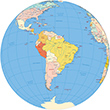
South America


In South America there are twelve developing countries and about 348 million people. It has the greatest linguistic integration of all the continents: the great majority of the people speaks Portuguese or Spanish.

The Amazon River, in South America, is the world's greatest river in volume of water and size of drainage basin. Its length of 6,400km is only slightly surpassed by the Nile River, with 6,671km. On the other hand, the flow of water per second at mouth in the Amazon River is 175,000 cubic meters, while in Nile River is only 3,100 cubic meters. A huge difference.

Visit also the web page dedicated to Brazil.


Lake Titicaca and coast of Peru (left). Titicaca, the largest freshwater lake in South America, is located in a depression in the Altiplano (high plains) between the eastern and the western range of the Andes Mountains. Lake Titicaca covers an area of 3200 square miles (8300 square kilometers), is nearly 120 miles (190 kilometers) long, and has an average width of 45 miles (72 kilometers). Fed by many mountain streams that border the Altiplano, the lake is drained only by the Desaguadero River, which flows south into Lake Poopó. Water levels can vary as much as 16 feet (5 meters) from season to season and year to year. Much of the lake water is lost through evaporation caused by intense sunshine and strong winds. Since the late 1980s, drought has plagued this region of the Altiplano, causing water levels in the lake to drop below normal. Drastic drops in water level in the lake could eventually affect the moderating climate of this high-altitude lake 12 500 feet (3800 meters) above sea level, which could lead to reduced agricultural crop yields. The agricultural crops of wheat and maize help sustain many Indians that live along Lake Titicaca’s shores. (by NASA).


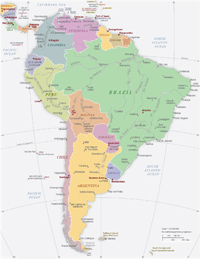
South America Political


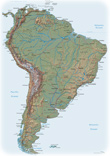
South America Map
Brazil


Galapagos Islands

The Galapagos is a group of volcanic islands in the Pacific Ocean. Some volcanoes in the islands are still active. They constitute a province of Ecuador and are protected as a wildlife sanctuary, since 1935, where birds coexist with iguanas, sea lions and several other animals. The principal islands are Isabela, San Cristóbal, San Salvador, Santa María and Santa Cruz. The islands population is about 15,000. Puerto Baquerizo Moreno, on San Cristóbal, is the administrative center. In 1978, it was declared a UNESCO World Heritage Site.

The Isolation of the Galapagos in the Pacific Ocean allowed the development of a peculiar ecosystem. Many varieties of wildlife are not found anywhere else, including six species of giant tortoises that give the islands their Spanish name. The observation of the wildlife in Galapagos produced important inferences to the development of the Charles Darwin's theory of evolution. The English naturalist arrived at the archipelago in the expedition of the Beagle, between 1831 and 1836.

The Galapagos Islands was discovered in 1535, by the bishop of Panama Tomás de Berlanga, when its ship drifted in a trip to Peru. He named the islands of "Las Encantadas". In his writings, the bishop emphasized the great number of giant tortoises (galapagos in Spanish) there were in the islands.

Galapagos attracts more than 60 thousand tourists annually and is considered the second biggest wildlife marine reserve of the world, only behind the Great Barrier Reef, in Australia.

The Bartolome Island, in Galapagos


The Bartolome Island, Galapagos.


Map of Galapagos

Guia Parana


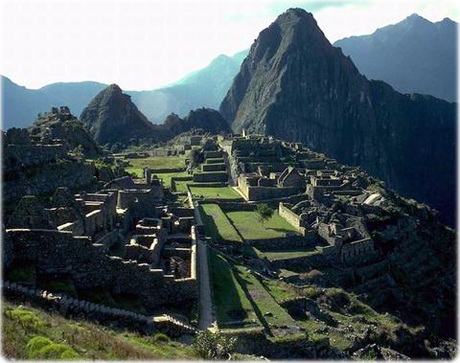
Machu Picchu - Peru

Place of the pre-Columbian Inca ruins, about 80 km northwest of Cuzco, in Peru. In 1983, Machu Picchu was declared a UNESCO World Heritage Site.

Machu Picchu was discovered in 1911 by the American explorer Hiram Bingham, also professor of the University of Yale. Bingham believed that these 18 square Km of terraced stonework might have been the last refuge of the Incas, fleeing from the Spanish conquerors, in the 16th century.

Machu Picchu stands on an altitude of 2,350 meters, in the Andes Mountains. It's the principal tourist attraction in Peru.

Map of Peru.

 Machu Picchu ruins, in Peru

Machu Picchu ruins, in Peru.

Rio de Janeiro


South America


Travel Guide


Blue-footed booby in Galapagos.


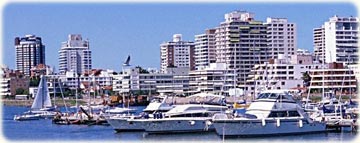
Punta del Este - Uruguay

Punta del Este, Uruguay.

Punta del Este - Uruguay

Punta del Este is a resort in the Atlantic coast of Uruguay. This cosmopolitan city has casinos, beaches and excellent structure for tourism.

The main beaches are Playa Mansa, on the Río de la Plata, and Playa Brava, on the Atlantic coast. La Barra del Maldonado, 5km east of Punta del Este, has also clean and beautiful beaches.

Map of Uruguay.


São Paulo SP


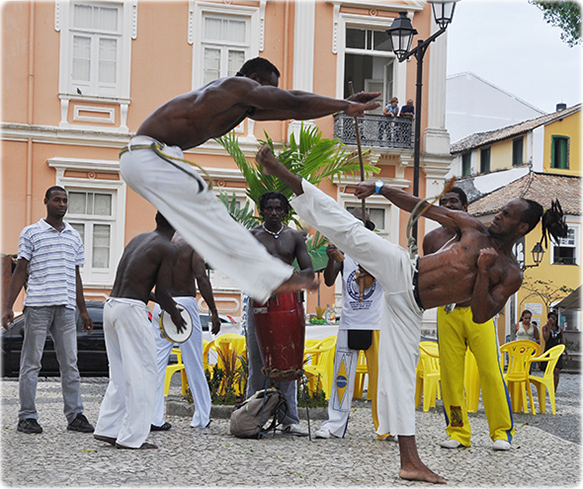
Brazil: A Nation with a Very Diversified Culture

Brazil's lands was officially discovered in 1500. It was ruled by Portugal until 1822, when Brazil became an independent country. After that, a huge number of immigrants, from Europe and Asia, arrived in search of a piece of land and a new life. Today, as a result, Brazil is a country with a very diversified culture, made by Europeans, Africans, Asians and native Americans.

Curitiba Brazil

Oscar Niemeyer Museum, the newest museum in Curitiba Brazil, state of Paraná.


Lake Titicaca Peru


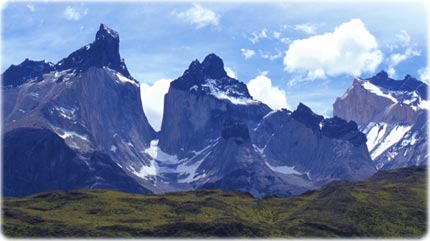
Torres del Paine National Park - The jagged granite mountains of Torres del Paine is a spectacle of colors and forms, located in the Chilean Patagonia, in Andes.


Buenos Aires - Argentina

Buenos Aires, located on the western bank of the Rio de la Plata, is the economic, political and cultural center of Argentina. It is a great metropolis with twelve million people with high cultural standard.

It is Frequently described as the most European city of the Latin America. The majority of the population descends from Spanish, Italian and German immigrants. They are responsible for a city with intense cultural activity.

The Plaza de Mayo is the principal urban center of Buenos Aires. Around this square, important buildings can be found, like the Casa Rosada (the presidential palace), the metropolitan cathedral, and the Cabildo (the colonial town council, now a museum). Map of Argentina

Buenos Aires - Argentina

The main avenue in Buenos Aires.


◄Geographic Guide


Google


Blue-footed booby in Galapagos

Pictures

About the Geographic Guide


Torres del Paine National Park