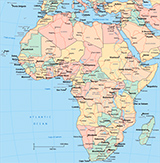
Physical Map of Africa

◄ Africa

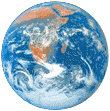
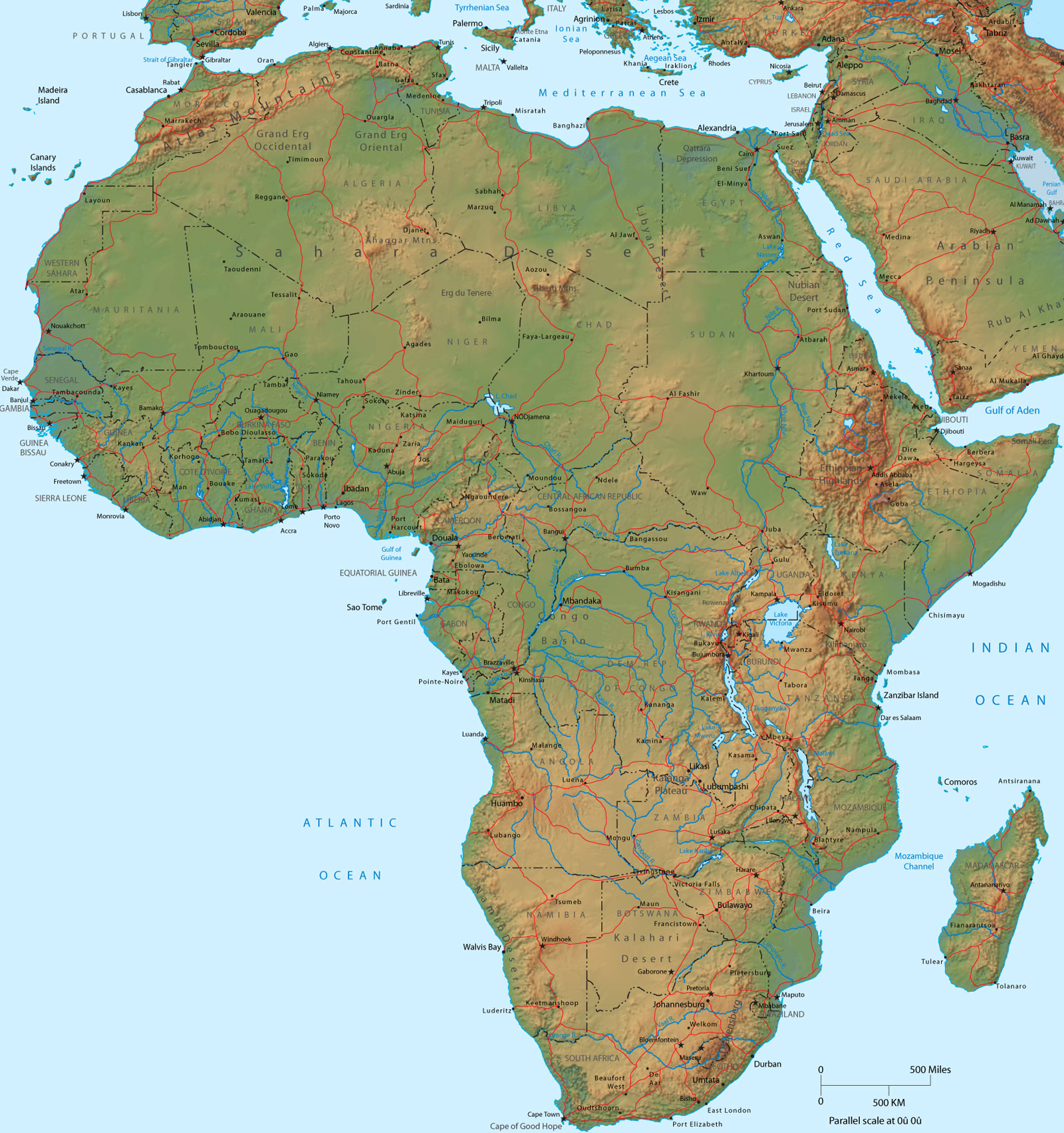
Map of Africa with its physiography (on the right, click to enlarge). The continent of Africa is spread across three of the major lines of latitude: the Tropic of Cancer, the Equator and the Tropic of Capricorn. It has eight major physical regions: the Sahara and Namib deserts, the Sahel, the Ethiopian Highlands, savannas, the Swahili Coast, rainforests, the African Great Lakes and Southern Africa. Africa is highly biodiverse and heavily affected by a wide range of environmental issues, including desertification, deforestation, water scarcity, and pollution.
African physiography is characterized by vast plateaus, great river basins, like Nile, Congo and Niger (descend from the surrounding plateaus), the Sahara, the world's largest desert, the East African Rift System, high volcanic peaks, such as Kilimanjaro (Africa's highest point), large lakes, including Victoria and Tanganyika, and regional features like the Ethiopian Highlands and the Congo rainforests.

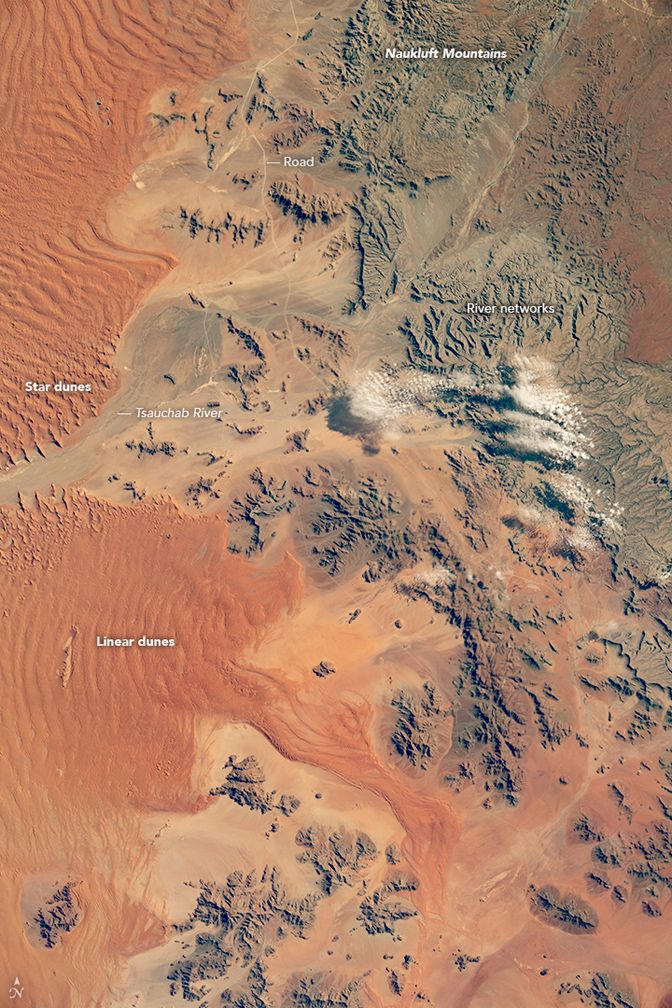
Part of the Namib Desert, photo taken on April 11, 2018 (NASA / International Space Station). Rainfall is negligible over the sand dunes here. This allows strong southerly winds to build up the north-south linear dunes. The mountainous landscapes are sculpted by rivers that occasionally flow with water. They appear as numerous finger-like river channels that flow down to the sand sea and evaporate.
Sahara Desert landscape. Below, a sub-Saharan landscape with elephants and mountains in the background.
Physical Map of Africa
|
Copyright © Geographic Guide - Travel, Geography of Planet Earth and Maps. |

Click to enlarge